
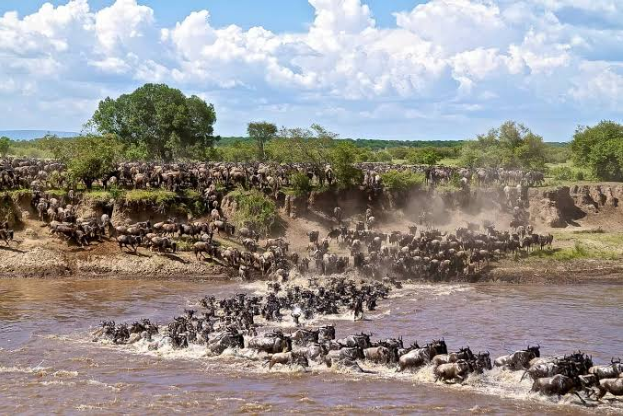
Every year, more than a million animals set out on a journey that has no beginning and no end. The Serengeti Great Migration is a continuous, clockwise loop across the plains of Tanzania and Kenya, driven by rain, grass and instinct. It is widely regarded as the largest overland mammal movement on Earth, and it consistently tops the wish list of safari travelers, photographers and conservationists alike.
This guide explains what the migration is, how it works month by month, where and when to see it, and how to plan a trip that puts you in the right place at the right time.
What Is the Serengeti Great Migration?
The Great Migration is the annual circular movement of roughly 1.5 million wildebeest, accompanied by around 200,000 zebras and hundreds of thousands of gazelles, eland and other grazers. Together they travel through the Serengeti ecosystem in northern Tanzania and the Maasai Mara in southern Kenya, covering a loop that is often estimated at 800 kilometers or more.
The herds do not follow a fixed calendar or a set route. They follow the rain. Seasonal showers trigger fresh, nutrient-rich grass, and the animals move toward it. This is why experienced guides say the migration is better understood as a living process than a scheduled event: timing shifts from year to year, and no two seasons look exactly alike.
The wider Serengeti ecosystem is protected by Serengeti National Park, the Ngorongoro Conservation Area and several neighboring reserves, and it was inscribed as a UNESCO World Heritage Site in 1981. In 2013, the migration was also named one of the Seven Natural Wonders of Africa.
Why Do the Animals Migrate?
The answer is simple: survival. The Serengeti is a landscape of two halves. The southern plains have short, mineral-rich grass that is ideal for pregnant and nursing females, but they dry out quickly. The northern and western regions have taller grass and more reliable water in the dry season, but lower nutritional quality.
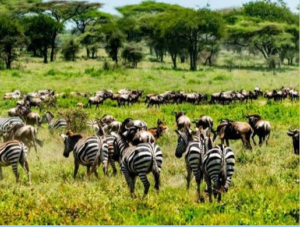
By moving between these zones, the herds balance food, water and safety. Wildebeest, with their strong herding instinct, are the main drivers. Zebras tend to lead because they graze the taller, coarser grass first, opening the way for wildebeest, which prefer the shorter growth that remains. Gazelles follow behind to feed on the shortest layer. This ecological sequence is one of the clearest examples of how grazing species share a landscape without exhausting it.
The migration also supports the entire food chain. Lions, hyenas, cheetahs, leopards, crocodiles and vultures all depend on its rhythms, and the dung and carcasses it leaves behind feed the soil that grows next year’s grass.
The Migration Month by Month
Because the herds follow rainfall, the following timeline is a reliable guide rather than a guarantee.
January to March: Calving Season in the Southern Serengeti
The herds gather on the short-grass plains around Ndutu and the southern Serengeti. Within a window of just a few weeks, hundreds of thousands of calves are born, with peak days seeing thousands of births. Within minutes, a newborn wildebeest can stand and run, a vital skill in a landscape full of predators.
This is the best period for predator action. Lions, cheetahs and hyenas concentrate around the herds, and sightings are frequent. It is also an excellent time for photographers, thanks to green landscapes and dramatic skies.
April to May: The Long Rains and the Move North
As the plains dry, the herds start moving north and west through the central Serengeti (Seronera) and toward the Western Corridor. Rains are heavy, lodges are quieter and rates are lower. Wildlife viewing is still good, but roads can be muddy and some camps close temporarily.
June to July: The Grumeti River Crossings
The herds gather in the Western Corridor and face their first major obstacle: the Grumeti River. Crocodiles wait in the water, and crossings can be dramatic. These are generally less crowded than the Mara River crossings, making them a rewarding alternative for travelers who prefer fewer vehicles.
July to October: The Mara River Crossings in the North
This is the migration’s most famous chapter. The herds reach the northern Serengeti and push toward Kenya’s Maasai Mara, crossing the Mara River in dense, chaotic waves. Steep banks, strong currents and large Nile crocodiles make each crossing a high-stakes event.
Crossings are unpredictable. Herds may gather at the bank for hours or days before something triggers a rush. Patience is essential, and the best experiences usually go to those who stay several nights in the north rather than rushing through.
November to December: The Return South
Short rains prompt the herds to leave the Mara and travel south through the eastern and central Serengeti. The landscape greens again, and the animals gradually return to the southern plains, where the cycle begins again with calving season.
Where to Stay: Seasonal Camps and Lodges
One of the most important planning decisions is where you base yourself. Because the herds are always on the move, many operators offer mobile tented camps that relocate with the migration. These camps put you close to the action without long daily drives and provide an immersive, authentic bush experience.
Permanent lodges, on the other hand, offer more comfort and amenities and are often a good choice in regions where the herds spend several weeks, such as the central Serengeti or the northern Kogatende area. Many travelers combine both styles in a single itinerary.
Tanzania or Kenya: Which Side Should You Choose?
The herds spend most of the year in Tanzania, and the Serengeti side offers the vast, open scale that defines the experience. The Kenyan Maasai Mara is smaller and more compact, which can make wildlife viewing more concentrated during the July to October crossings.
Tanzania is generally the better choice for those who want to see the full cycle, including calving season, while Kenya can be an excellent add-on for the river crossings. A combined itinerary is possible, but it requires careful planning around border logistics and park fees.
Tips for Planning Your Migration Safari
- Book early. The most popular camps in the northern Serengeti and Ndutu fill up many months in advance, especially for July to October and January to March.
- Stay at least three to four nights in your chosen region. Because behavior is unpredictable, extra time increases your chances of witnessing a crossing or a calving.
- Choose a reputable operator with experienced guides who track herd movements closely and know how to position vehicles ethically.
- Consider a balloon safari. Drifting over the plains at sunrise offers a perspective that ground-level game drives cannot match.
- Pack for variety. Neutral clothing, layers for cool mornings, a good camera with a telephoto lens and binoculars all make a difference.
- Respect the wildlife. Keep your distance, never leave the vehicle outside permitted areas and follow your guide’s instructions.
Conservation Challenges and Responsible Travel
The migration remains one of the few intact large-scale migrations left on the planet, but it is not immune to pressure. Habitat loss on the ecosystem’s borders, illegal bushmeat hunting, climate variability and proposed infrastructure projects are all ongoing concerns. Prolonged droughts can have severe effects on herd numbers and calf survival.
Tourism plays a critical role in funding protection, anti-poaching patrols and community programs. Travelers can support this by choosing operators that employ local guides, contribute to conservation initiatives and follow low-impact practices. Responsible tourism helps ensure the migration continues for future generations.
Conclusion
The Serengeti Great Migration is more than a wildlife event. It is an ecological engine that shapes the landscape, sustains predators and prey alike, and connects two countries in a single, ancient cycle. Whether you witness the drama of calving season in the south, the tension of a Mara River crossing in the north, or the quiet movement of vast herds across open plains, the experience is humbling and unforgettable.
The key to a successful trip is flexibility, patience and good local knowledge. Plan around the rains rather than the calendar, give yourself enough time in each region, and travel responsibly. Do that, and you will see one of the last great wildlife spectacles on Earth the way it was meant to be seen.
Key Takeaways
- The Great Migration involves roughly 1.5 million wildebeest plus hundreds of thousands of zebras and gazelles, moving in a clockwise loop through Tanzania and Kenya.
- Rainfall and fresh grass drive the movement, so timing varies year to year.
- January to March is best for calving and predator action in the southern Serengeti.
- July to October is the prime window for dramatic Mara River crossings in the north.
- Plan at least three to four nights per region to improve your chances of seeing key moments.
- Mobile camps offer closeness to the herds, while permanent lodges offer comfort and stability.
- Responsible tourism directly supports conservation of the ecosystem.
Frequently Asked Questions (FAQ)
When is the best time to see the Serengeti Great Migration?
There is no single best time, because the migration happens all year. For river crossings, aim for July to October. For calving and predator activity, choose January to March. For fewer crowds and lower prices, consider April to May or November.
Where does the Great Migration take place?
It occurs across the Serengeti ecosystem in northern Tanzania and the Maasai Mara National Reserve in southern Kenya, including the Ngorongoro Conservation Area and surrounding protected lands.
How many animals take part in the migration?
Estimates commonly cite around 1.5 million wildebeest, along with roughly 200,000 zebras and several hundred thousand gazelles and other antelope. Numbers fluctuate with rainfall and ecological conditions.
Is the Great Migration guaranteed to happen at the same time every year?
No. The timing and exact route depend on rainfall patterns, so dates shift from year to year. Reputable operators track the herds and adjust your itinerary accordingly.
Can I see a river crossing every time I visit?
Not guaranteed. Crossings are spontaneous, and herds may wait for hours or days. Staying several nights in the northern Serengeti or the Mara greatly improves your chances.
Is the Serengeti or the Maasai Mara better for the migration?
Both are excellent. The Serengeti offers more space and covers the full yearly cycle, while the Mara is compact and well known for its July to October crossings. Many travelers visit both.
How long should I plan for a migration safari?
A minimum of five to seven days is recommended, with at least three to four nights in the region where you most want to see the herds. Longer trips allow for flexibility and a deeper experience.